Most companies use legacy ERP systems that usually result in fragmented business processes and a lack of real-time visibility, making it difficult for them to adapt to any market changes, manage expenses, and provide a seamless customer experience. SAP S/4HANA is an intelligent ERP solution designed to overcome these challenges.
This will help companies operate efficiently and increase their effectiveness while maintaining business agility and customer satisfaction. This blog explores the advantages of SAP S/4HANA implementation steps and its integration with other systems.
Why SAP S/4HANA Migration is Now Important for Companies
As the support of SAP ECC approaches the 2027 end date, there is an increased need to upgrade existing ERP solutions to be prepared for the future. By keeping the old system in use, it is impossible to provide fast and flexible operations. Therefore, considering the SAP S/4HANA migration is a necessity.
The solution allows enterprises to keep up with changes in the market, ensure efficient operations, and implement measures for the development of a business. This cloud ERP solution from SAP has all the needed features for simplifying processes and establishing a connected ecosystem.
The advantages of SAP S/4HANA over classical ERP solutions include:
- Advanced Technology: This solution has its own SAP HANA in-memory database, which offers fast processing and shows real-time analytics for better decision-making and operational efficiency, while ERP relies on traditional databases, leading to complexity.
- Structured Data Model: S/4HANA features a simplified data model which reduces data redundancy. On the other hand, ERP has a more complex and redundant data structure. In short, S/4HANA enables more efficient data management.
- Deployment Options: The S/4HANA system comes with both cloud and on-premises installation choices. It is more flexible than traditional ERP systems. This flexibility allows companies to choose a deployment model that aligns with their IT strategies.
Key Benefits of SAP S/4HANA Implementation
Migrating to an intelligent ERP system provides various benefits that optimize business operations. These are as follows:
Real-Time Processing
In SAP S/4HANA, the use of cutting-edge in-memory computing technology allows for processing enormous amounts of data in real time. Hence, companies can get quick business insight, monitor their operations, and make decisions based on this information.
The industries like manufacturing, retail, health care, and finance could get the most benefits with real-time processing, such as better visibility, predictive analysis, and real-time reporting.
User Experience with SAP Fiori
SAP S/4HANA provides a seamless interface experience with the use of SAP Fiori, and businesses can use this framework to improve their usability and effectiveness in business process management. This framework includes individualized dashboards, role-based access, mobile interface capability, easy navigation, and real-time business insights. The features will allow users to have faster access to important data and thus make timely decisions.
Scalability and Cloud Readiness
SAP S/4HANA supports multiple deployment models, including:
- On premises
- Private cloud
- Public cloud
- Hybrid cloud
This flexibility allows businesses to align ERP modernization with their long-term cloud transformation strategy.
Intelligent Automation and AI Capabilities
However, SAP S/4HANA Cloud Public Edition comes equipped with Artificial Intelligence (AI) for business processes that integrate SAP Business AI, generative AI, and the Joule digital assistant to automate tasks
These intelligent features help ensure greater precision, minimize operational risks, and boost business agility.
SAP S/4HANA Cloud Public Edition has its own Artificial Intelligence (AI) into business processes, which combines SAP Business AI, generative AI, and the Joule digital assistant to automate key.
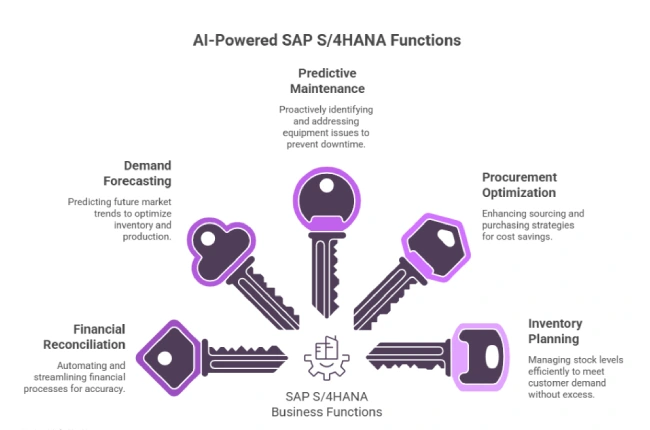
These intelligent capabilities improve accuracy, reduce operational risks, and increase business agility.
Key Steps for Successful SAP S/4HANA Implementation
Migration to SAP S/4HANA is a big step towards the transformation of the business. This will have an impact on various important areas within a business, including finance, supply chain management, procurement, sales, production, and reporting. The success of migration depends on many factors, including objectives, planning, data accuracy, and process alignment.
-
Step 1: Assess Business Readiness
Before implementation, companies should:
- Define business goals
- Evaluate current infrastructure
- Assess existing systems
- Identify process gaps
- Review data quality
A proper readiness assessment helps reduce implementation risks.
-
Step 2: Choose the Right Implementation Approach
Businesses can select from three main implementation strategies:
- Greenfield Implementation: A completely new implementation designed to redesign business processes from scratch.
- Brownfield Implementation: A system conversion approach that upgrades existing SAP ECC systems to SAP S/4HANA.
- Hybrid Approach: A selective transformation strategy that combines Greenfield and Brownfield elements.
The right choice depends on business objectives, timelines, and operational complexity.
-
Step 3: Data Migration and Validation
Data migration is one of the most important stages of implementation.
Best practices include:
- Data cleansing and standardization
- Removing duplicate records
- Validating critical business data
- Automating migration activities
- Performing multiple testing cycles
Clean and accurate data ensures system reliability and smooth business operations.
-
Step 4: Enable Seamless Integration
Organizations should:
- Identify critical business applications
- Enable API-based integration
- Ensure secure data exchange
- Test system interoperability
- Remove integration bottlenecks
A connected ERP environment improves operational efficiency and collaboration.
-
Step 5: Focus on User Training and Change Management
Technology transformation succeeds when employees are prepared for change.
Organizations should invest in:
- Role-based training
- Employee engagement programs
- Continuous learning initiatives
- Change management frameworks
- Knowledge transfer sessions
Strong user adoption is essential for successful ERP transformation.
-
Step 6: Monitor and Optimize Performance
After deployment, businesses should continuously monitor:
- System performance
- User adoption
- Operational KPIs
- Integration efficiency
- Process bottlenecks
Continuous optimization helps maximize ROI and long-term business value.
Conclusion
The implementation and integration of SAP S/4HANA are changing the way enterprises are operating and innovating. Through real-time analytics, intelligence, automation, process integration, and scalability. This solution allows enterprises to have an agile and flexible operation.
ERP transformation involves many factors, but proper planning, implementation, and integration, as well as optimization, should be done in order to succeed in the whole process. By following best practices and integrating the SAP S/4HANA implementation into the overall digital transformation, organizations can derive much benefit from the transformation process.
Partner with Emergys to accelerate your SAP S/4HANA transformation with expert guidance and seamless implementation. Contact us today to start your transformation journey.
FAQs
-
What is SAP S/4HANA and how is it different from ECC?
SAP S/4HANA is SAP’s next-generation ERP platform designed to help organizations operate as intelligent enterprises. Built on the SAP HANA in-memory database, it delivers real-time analytics, simplified data structures, faster processing, and a modern user experience through SAP Fiori. Unlike SAP ECC, SAP S/4HANA supports advanced capabilities such as AI, automation, predictive analytics, and intelligent business processes, making it the preferred platform for future-ready organizations.
-
Why do companies need to migrate from SAP ECC?
With SAP ECC approaching the end of mainstream maintenance in 2027, organizations must start preparing for the transition to SAP S/4HANA. Migrating enables businesses to maintain SAP support, improve operational efficiency, reduce technical debt, and leverage innovations such as AI-driven insights, automation, and real-time reporting. Delaying migration can increase project risks, resource constraints, and implementation costs as the 2027 deadline approaches.
-
How long does an SAP ECC to S/4HANA migration take?
The timeline for an SAP ECC to SAP S/4HANA migration typically ranges from 6 to 18 months, depending on system complexity, data volume, customizations, integrations, and the chosen migration approach. As the 2027 SAP ECC support deadline draws closer, organizations should begin planning early to avoid resource shortages, minimize business disruption, and ensure a smooth ERP transformation.
-
What should organizations consider for SAP S/4HANA implementation and integration?
A successful SAP S/4HANA implementation requires careful planning around business processes, data migration, system architecture, and user adoption. Organizations should also evaluate how SAP S/4HANA will integrate with existing enterprise applications such as CRM, MES, PLM, eCommerce, HR, and third-party systems. Leveraging modern integration platforms and APIs ensures seamless data flow, improved operational visibility, and end-to-end business process automation.
-
How does SAP S/4HANA integrate with other business systems?
SAP S/4HANA is designed to seamlessly integrate with SAP and non-SAP applications across the enterprise. It supports integration with CRM platforms, supply chain systems, manufacturing solutions, cloud applications, analytics tools, and third-party software through APIs, middleware, and SAP Integration Suite. Effective SAP S/4HANA integration enables real-time data exchange, streamlined workflows, improved decision-making, and a connected digital enterprise, helping organizations unlock greater value from their ERP investment.