Introduction
The process of enterprise operation is based on the transactions involved in procurement, logistics, finance, and accounts payable. However, sometimes there are delays and unhandled exceptions that cause considerable manual work, which leads to late payments, strained relationships with suppliers, and a lack of visibility of operations.
A mismatch between a Purchase Order (PO), a Goods Receipt (GR), and a supplier invoice might look small on paper. At scale, though, these discrepancies pile up and create real downstream impact. Someone must investigate, validate the data, reach out to the vendor, decide on a fix, and update the system, usually hopping between processes that do not talk to each other. Traditional invoice management leans on predefined rules, manual reviews, and workflow automation. That approach cuts out some of the repetitive work, but it becomes challenging when an exception needs actual judgment or coordination across several data points.
Agentic AI offers a different way; it is AI-Driven SAP Auto Invoice Management. Instead of simply flagging exceptions, an AI agent can interpret them, understand the business context behind them, recommend the right action, and initiate the resolution itself. That is the real shift from simply spotting invoice exceptions to intelligently resolving them. With AI-Driven SAP Auto Invoice Management, organizations can move from reactive exception handling to proactive, context-aware invoice management.
The Business Impact of Unmanaged Exceptions
SAP exceptions commonly emerge when transactional data does not align across procurement and financial processes.
Some of the most frequent causes include
Quantity issues
The quantity in the Purchase Order (PO) is different from the quantity received or invoiced. Such mismatch could be partial shipments, incorrect invoices, damage to items, or receiving errors.
Price differences
Where the invoice price is different from the agreed price, it usually means that procurement will have to go through the contract and supplier correspondence.
Delivery variance
Where the goods arrive early or late.
Individually, these exceptions may be manageable. At enterprise scale, however, thousands of exceptions can create a substantial operational burden.
Why Traditional Invoice Management Falls Short
Invoice management in traditional SAP is performed in a one-way manner like Detect, Notify, Investigate, Decide, Resolve.
Although this approach offers a structured workflow, decision-making is carried out based on information processing performed by people.
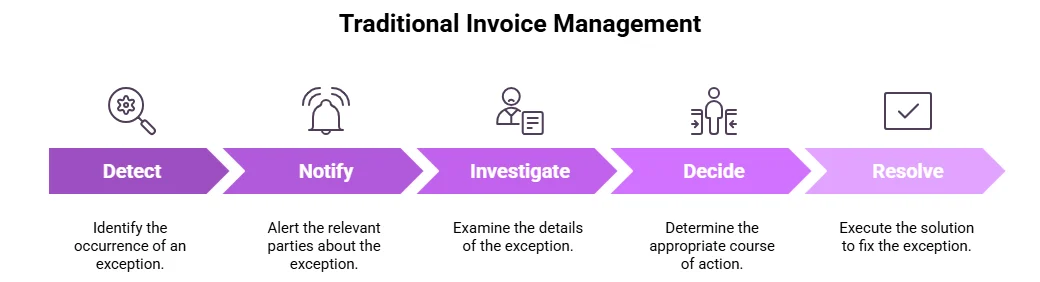
For example, a rule-based automation may flag an invoice because its quantity exceeds the corresponding PO quantity. But identifying the exception is only the beginning. The real challenge is understanding why it occurred and what action should follow.
Among other exceptions, the following questions need to be answered:
- Was the extra quantity approved separately?
- Has the PO been changed, but not synchronized?
- Is it a recurring problem with this supplier?
- Does the vendor have problems delivering the goods on time?
- Should the invoice be blocked, escalated, or accepted?
This is where Agentic AI changes the operating model.
Agentic AI for SAP Invoice Management
Agentic AI enables SAP invoice management to move beyond static rules and predefined workflows. Instead of simply identifying an exception, an AI agent can analyze the surrounding business context, evaluate relevant information, and determine an appropriate next step based on organizational policies and business rules.
The result is a more intelligent exception-resolution lifecycle:
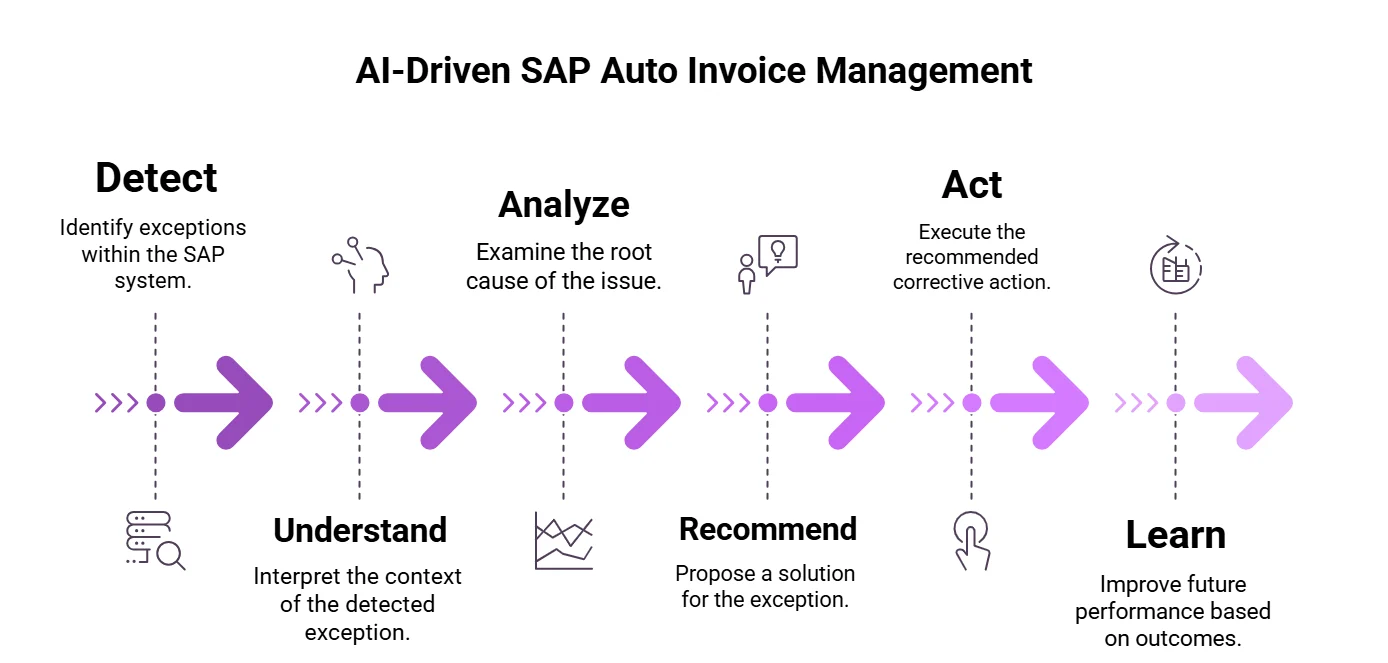
The AI agent becomes an intelligent layer between SAP transactional data and business processes, helping teams transform exception queues into actionable workflows.
How an AI Agent Works in Auto Invoice Management
-
Automated Exception Detection and Data Fetching
SAP recognizes exceptions in the transaction process as the first step. Agents running in the background can supply data related to the exceptions, such as Purchase Order (PO), Goods Receipt (GR), Invoice, Vendor, Quantity, Price, Delivery, etc., to the AI agent.
Users do not have to collect data from different transactions to obtain information on an exception. -
Contextual Analysis
The AI agent analyzes the exception in its proper context. In case of a quantity discrepancy, the AI agent is capable of analyzing:
- PO Quantity
- GR Quantity
- Invoice Quantity
- Vendor history
- Past Exceptions
- Applicable Business Rules
- Patterns of Delivery
- Transaction Context
Such an approach enables the system to separate routine discrepancies from those that require human intervention.
-
Intelligent Recommendations
According to the context and business policy configured, the agent will be able to recommend the right course of action.
Recommendations may include:
- Correction of PO
- Creation of an internal alert
- Escalation
- Clarification from the vendor
- Vendor exceptions
- Appropriate business team for exception handling
It is not about automation but rather context-aware decision making.
-
Automated Communication
After the right course of action is identified, the AI agent is then able to make the process of communication simpler.
For instance, various exceptions that exist for the same invoice can all be put together into one vendor for communication instead of having separate communications for each exception.
-
Workflow Execution
Where necessary, the agent can trigger downstream processes or activities based on the control and authorization policy in place.
This will create a closed-loop system whereby exceptions are escalated from detection to resolution without the need for manual coordination of the activities.
Business Value of AI-Driven SAP Invoice Management
Accelerate Exception Resolution
Automated analysis and workflow initiation can reduce the backlog of unhandled exceptions and help teams resolve issues faster.
Reduce Manual Intervention
By automating repetitive investigation, communication, and routing activities, finance and procurement teams can redirect their time toward higher-value activities.
Strengthen Vendor Management
Exception patterns can provide greater visibility into supplier performance. Recurring late deliveries, pricing discrepancies, or invoice errors can be surfaced for proactive vendor management.
Improve Operational Visibility
A centralized, intelligent view of exceptions helps organizations understand where processes are creating friction and where intervention is most frequently required.
Enable Scalable Operations
As transaction volume grows, organizations can process an increasing number of exceptions without scaling manual intervention at the same rate.
Support Clean-Core Strategies
An AI-driven exception-management architecture can complement SAP’s modernization strategy by using intelligent services and extensions while minimizing unnecessary changes to the SAP core.
Conclusion
SAP-based invoice management is moving from the reactive way of handling problems to intelligent action based on context. By utilizing SAP-based information, business logic, context-based reasoning, intelligent suggestions, and workflow management, Agentic AI enables firms to handle exceptions faster and avoid any manual work to focus on decision making and improved relationships with their suppliers.
Emergys help companies evolve SAP invoice management using Agentic AI to resolve exceptions automatically. Connect with us to Accelerate Intelligent SAP Operations.
FAQs
-
What is AI-powered invoice management in SAP?
AI-powered invoice management in SAP uses artificial intelligence and Agentic AI to automate invoice processing, analyze exceptions, understand business context, and recommend or execute appropriate actions. It helps organizations reduce manual intervention and improve the efficiency of accounts payable and finance processes.
-
How does Agentic AI improve SAP invoice management?
Agentic AI improves SAP invoice management by going beyond simply detecting invoice exceptions. An AI agent can analyze purchase orders, goods receipts, invoices, vendor history, pricing, quantities, and business rules to determine the appropriate next step and initiate workflows when authorized.
-
What are common invoice exceptions in SAP?
Common SAP invoice exceptions include purchase order and invoice quantity mismatches, price discrepancies, goods receipt variances, delivery issues, incorrect invoice data, and recurring supplier-related errors. AI-powered invoice management can help identify, analyze, prioritize, and resolve these exceptions more efficiently.
-
Can Agentic AI automatically resolve invoice exceptions?
Yes. Depending on the organization’s business rules, authorization policies, and SAP environment, Agentic AI can recommend actions and trigger downstream workflows for eligible invoice exceptions. Complex or high-risk exceptions can still be escalated to the appropriate business team for human review.