Introduction
Artificial Intelligence’s last decade has been a “training” era. Headlines were dominated by the massive compute clusters, petabytes of data, and billions of dollars required to train foundation models. But as these models become better, the industry is shifting into an operational phase. The new challenge is not building the model but figuring out how to serve users reliably and fast.
This shift has given rise to a new specialized discipline: Inference Engineering. Often operating at the intersection of traditional System Engineering and machine learning, inference engineering is the craft of making AI work in the real world.
To understand why inference engineering has become the most valuable category in AI operations, we must understand how inference works and the engineering layers required to sustain it.
What is Inference Engineering?
According to Philip Kiely, author of the 2026 book Inference Engineering (Baseten Books), inference engineering is the discipline of serving generative AI models in production. It spans the entire technology stack, from optimizing low-level CUDA kernels and memory layouts on a GPU to managing high-level autoscaling policies in a Kubernetes cluster.
Inference is the phase that follows training. It is the process of taking trained models, feeding it a prompt, and generating output. For an LLM, this means generating response to one token at a time. Kiely asserts that doing inference well requires mastering three distinct layers:
- Runtime: Single-instance optimization (getting the absolute most out of a single GPU)
- Infrastructure: Scaling across clusters, regions, and clouds
- Tooling: The platforms and utilities that allow developers to deploy and monitor these models
The explosion of capable open-weight models (with over two million currently available on platforms like Hugging Face) means that companies no longer rely on closed APIs. By managing their own inference, organizations can tweak models for lower latency, ensure higher uptime, and drastically reduce costs—sometimes by as much as 80% at scale. However, to achieve these gains, they must employ rigorous inference and system engineering practices.
The Mechanics of LLM Inference: Prefill and Decode
To understand the challenges of inference engineering, let us break down how an LLM processes a request. As highlighted in discussions around ByteByteGo’s Guide to AI Inference Engineering, inference is split into two distinct phases: Pre-fill and Decode.
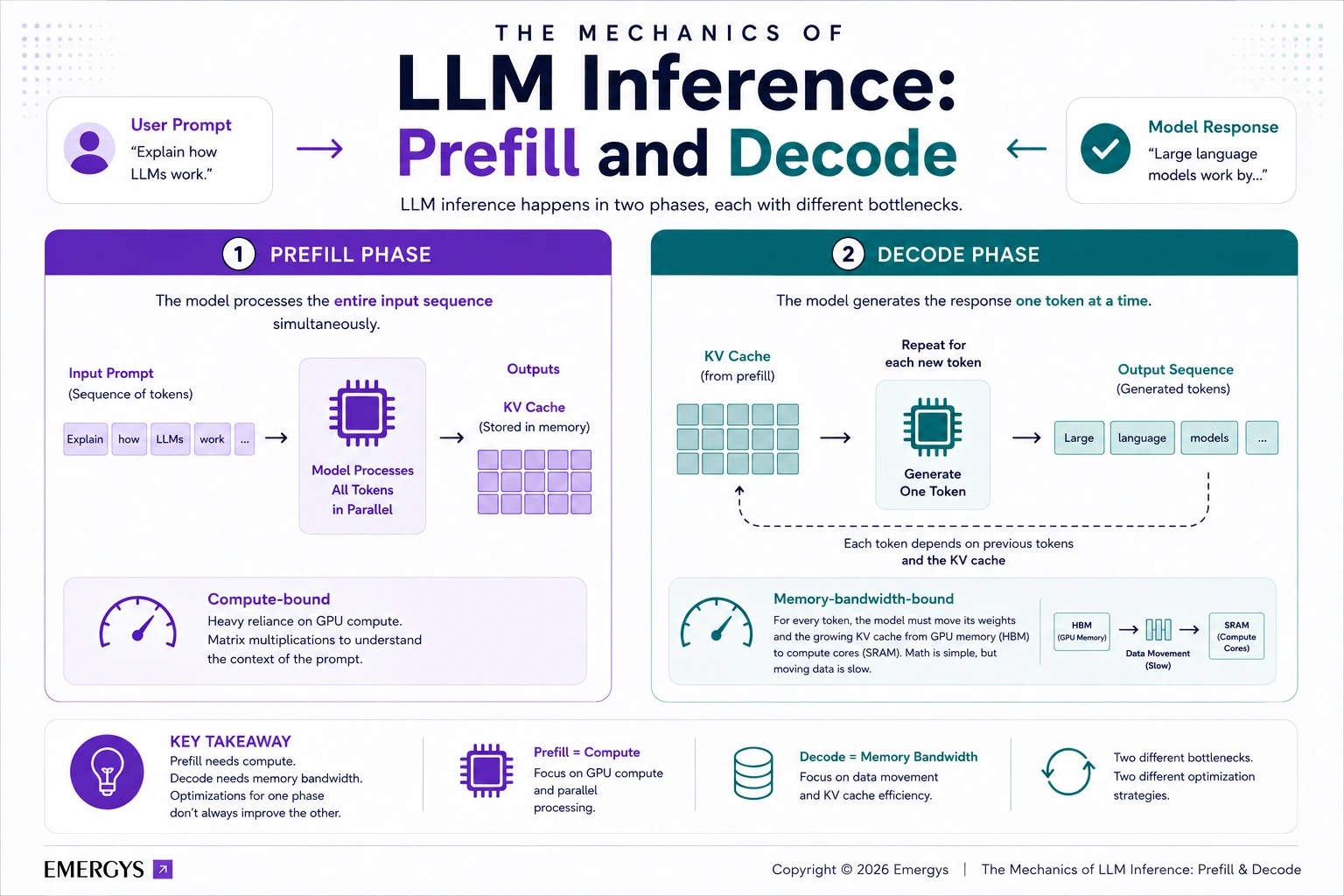
The Prefill Phase
When a user submits a prompt, the model processes the entire input sequence simultaneously. This is the prefill phase. The model calculates the attention scores for all the tokens in the prompt and generates the Key-Value (KV) cache.
Compute-bound: The prefill phase is heavily reliant on processing power. The GPU’s compute cores are saturated as they perform matrix multiplications to understand the context of the prompt.
The Decode Phase
Once the prompt is processed, the model enters the decode phase, it generates the response with one token at a time. Crucially, each token depends on the previously generated tokens and the KV cache from the prefill phase.
Memory-bandwidth-bound: The decode phase is fundamentally constrained by memory bandwidth. For every token generated, the model must move its set of weights and the growing KV cache from the GPU’s high-bandwidth memory (HBM) into its compute cores (SRAM). The math is relatively simple, but moving the data is incredibly slow.
This prefill/decode split is the foundational concept that clarifies why inference optimization is so difficult. Techniques that improve prefill (which needs compute) do not necessarily improve decode (which needs memory bandwidth).
System Engineering in the Age of Inference
Because LLM inference is severely bottlenecked by memory bandwidth during the decode phase, system and inference engineers have developed a suite of optimization techniques to rearrange memory traffic and manage hardware constraints.
Here are the critical system engineering strategies used to optimize inference:
- Attention Variants: The standard Multi-Head Attention (MHA) used in original transformers consumes an enormous amount of memory for the KV cache. Engineers have traded some model quality for gains in speed and memory efficiency:
- Multi-Query Attention (MQA) & Grouped-Query Attention (GQA): By sharing K/V heads across multiple query heads, models like Llama 3 and Mistral shrink the KV cache footprint significantly, allowing larger batch sizes.
- Multi-head Latent Attention (MLA): DeepSeek pioneered this approach, compressing the K/V cache into a low-dimensional latent vector to drastically reduce memory usage with negligible quality loss.
- Memory-Traffic Rearrangement: To combat the memory-bandwidth bottleneck, inference engineers use software techniques to keep data close to the compute units:
- Flash Attention: Kernel-level optimization fuses the attention operation to stay within the fast on-chip SRAM, avoiding the slow trip to HBM.
- Paged Attention: Inspired by operating system virtual memory, this technique (foundational to engines like vLLM) manages the KV cache in non-contiguous pages, eliminating fragmentation and improving GPU utilization.
- Prefix Caching: If thousands of users share the same system prompt, prefix caching computes the KV values for that prompt once and reuses it across all requests, saving immense amounts of compute and memory.
- Disaggregation and Parallelism: When dealing with high traffic, a single GPU is not enough. System engineering dictates how workloads are split:
- Prefill/Decode Disaggregation: Because prefill and decode have different hardware bottlenecks, advanced setups route prefill compute to one set of GPUs and decode memory traffic to another
- Parallelism: Models are sharded across multiple GPUs using Tensor, Pipeline, or Expert parallelism to fit within memory constraints and improve throughput
- Speculative Decoding and Quantization: Speculative Decoding: A smaller, faster “draft” model generates a sequence of potential tokens, and the large “target” model verifies them in a single forward pass. This leverages the compute power of the prefill phase to speed up the decode phase.
- Quantization: Reducing the precision of the model’s weights (e.g., from FP16 to INT8 or INT4) reduces memory footprint and increases speed, which is a hard requirement for deploying on edge devices.
The Build vs. Buy Calculus
The inference engineering principles beautifully apply to cloud-scale deployments, but they also highlight the changing dynamics of AI.
Companies must decide whether to rent inference through an API (like AWS Bedrock or OpenAI) or build their own infrastructure to host open-weight models. Renting an API means someone else has solved the complex prefill-versus-decode batching for you; you are effectively buying inference engineering as an unbundled service.
However, for teams with system engineering capabilities, hosting open models offers control over latency, data privacy, and reduced costs. As inference moves beyond the data center to edge AI deployments (mobile silicon, IoT devices), the constraints become tighter. On-device inference requires brutal quantization and strict memory management, making inference engineering a hard requirement rather than cost optimization.
Inference engineering is no longer a niche subfield; it is the operational reality of modern AI. From CUDA kernels to global load balancing, the engineers who can master the prefill/decode split and navigate the memory bandwidth bottlenecks will be the ones who define the next generation of AI products.
Author:
Sagar Karmarkar
Associate Vice President | Emergys
With 28 years of IT experience, specializing in AI infrastructure, HPC, strategic partnerships, business incubation, and building high-performing teams to deliver innovative, enterprise-grade engineering solutions.
FAQs: Inference Engineering
-
What is the difference between AI training and AI inference?
Training is the process of teaching an AI model by feeding it massive amounts of data so it can learn patterns and relationships. Inference is the operational phase where the trained model is put to work, taking new inputs (prompts) and generating outputs (predictions or text).
-
Why is the “decode” phase of LLM inference so slow?
The decode phase generates text one token at a time. For every single token, the model must load its entire set of weights and the growing KV cache from the GPU’s memory (HBM) into its compute cores. This makes the decode phase “memory-bandwidth-bound,” meaning the bottleneck is how fast data can move, not how fast the math can be calculated.
-
What is PagedAttention?
PagedAttention is a system engineering technique inspired by operating system virtual memory. It manages the LLM’s KV cache in non-contiguous blocks or “pages,” which eliminates memory fragmentation and allows the GPU to process much larger batch sizes efficiently.
-
What is Speculative Decoding?
Speculative decoding uses a small, fast “draft” model to guess the next several tokens in a sequence. The large, slow “target” model then verifies these guessed tokens all at once. If the draft model guesses correctly, the system generates multiple tokens in the time it usually takes to generate one, bypassing the memory-bandwidth bottleneck of the decode phase.
-
Should my company build our own inference infrastructure or use an API?
Using an API (like OpenAI or Anthropic) is easier because the provider handles all the complex inference engineering. However, building your own infrastructure using open-source models allows for much greater control over latency, strict data privacy, and significantly lower costs at high volumes. The choice depends on your team’s Inference engineering expertise and the scale of your workload. Know more about our Cross platform Agent Services.