Introduction
The enterprise software landscape has reached a point of contention. Over the decade, companies have invested heavily in specialized software platforms: SAP or Oracle for ERP, Salesforce for CRM, Workday for HRMS, ServiceNow, Freshworks or BMC for ESM, and Power BI for analytics. A Cross-platform AI assistant can help unify these systems by enabling users to interact with data and applications across the enterprise.
While these platforms excel at their core functions, they have unintentionally created transactional silos. Employees spend hours jumping between fragmented portals, running manual exports, re-keying data, and manually connecting the dots across disparate applications.
For AI Leaders, the challenge is clear: How do you orchestrate intelligence across these systems without introducing complex point-to-point integrations or risking security breaches?
Enter EMY, Emergys’ Cross-platform AI Assistant service. Rather than acting as another off-the-shelf software that sits in your tech stack, EMY is delivered as an ongoing, enterprise-grade service. It acts as an intelligent neural layer sitting above your existing ecosystem, allowing users across every business function to query, analyze, and act across platforms using simple natural language.
Why Enterprise AI is a Service, not a Product
Current AI products fail in enterprise environments. Pre-packaged products cannot dynamically adjust to custom API endpoints, complex schema changes, evolving compliance rules, or tailored company business logic.
Emergys approaches enterprise intelligence through a service delivery model:
System Integration & Maintenance: As your internal tools (SAP, Salesforce, Workday, custom REST APIs) evolve, Emergys manages the underlying data pipelines, agent orchestrations, and API connectors.
Custom Persona & Workflow Engineering: Rather than forcing your teams into rigid templates, we build, fine-tune, and extend agentic capabilities to match your specific business processes.
Enterprise Security & Governance Guardrails: We maintain and monitor security boundaries, role-based access control (RBAC), data masking, and regulatory compliance standards continuously.
Architecture of the EMY Cross-Platform Ecosystem
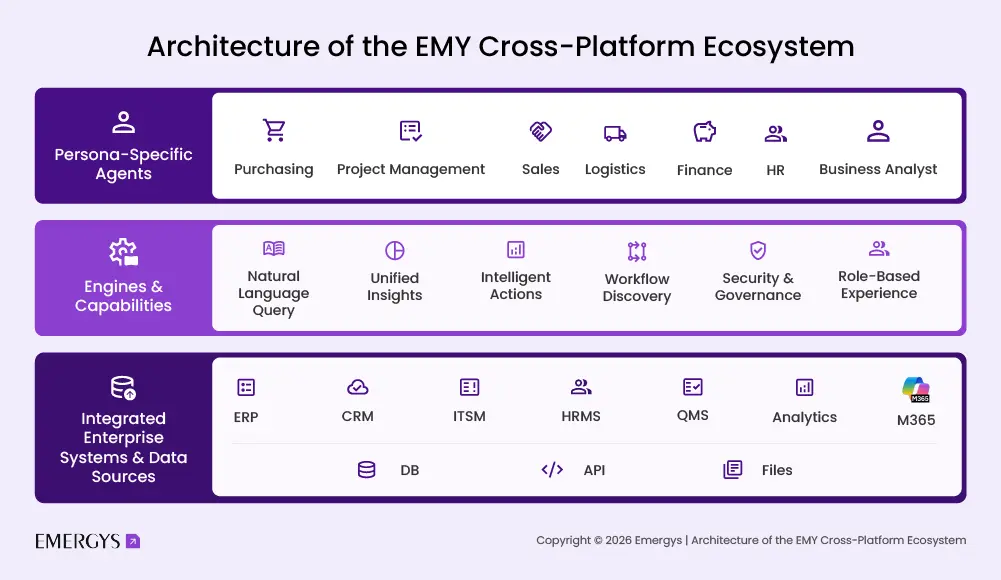
Cross-platform AI Assistant strength is in its architecture. EMY bridges the gap between front-end user intent and back-end enterprise infrastructure through two primary layers:
-
The Core Capabilities Engine
At the center of the architecture, EMY leverages multi-modal reasoning and agentic workflows to execute tasks:
- Natural Language Query: Enables conversational interaction with structured and unstructured data across the entire enterprise stack.
- Workflow Discovery: Maps relationships across processes, discovering dependencies between cross-system workflows.
- Unified Insights: Synthesizes isolated data points into immediate executive context.
- Intelligent Actions: Triggers cross-platform transactional workflows (e.g., creating a purchase requisition, updating a CRM record, and sending a Teams notification in one step).
- Security & Governance: Enforces enterprise-grade security, data encryption, compliance controls, and audit trails.
- Role-Based Experience: Customizes dashboards, data visibility, and permitted actions to match exact user credentials and job roles.
-
Deep Integration Across the Tech Stack
EMY connects directly to your core data sources through secure enterprise connectors and APIs:
- Enterprise Resource Planning (ERP): SAP, Oracle, Microsoft Dynamics 365
- Customer Relationship Management (CRM): Salesforce, Microsoft Dynamics
- IT Service Management (ITSM): ServiceNow, BMC, Jira, Freshworks
- Human Resource Management Systems (HRMS): Workday, SAP SuccessFactors
- Quality Management Systems (QMS): ETQ, TrackWise
- Business Intelligence & Analytics: Power BI, Tableau, Qlik
- Productivity Suites: M365 (SharePoint, Teams, Outlook)
- Underlying Databases & Files: SQL, Oracle, MySQL, PostgreSQL, REST/GraphQL APIs, CSVs, PDFs, Excel, and Word documents
How EMY Cross-platform AI Assistant Empowers Business Leaders: 7 Sample Persona Use Cases
A Cross-platform AI must deliver real-value outcomes tailored to individual business roles. Below is how EMY transforms daily operations for key enterprise personas by eliminating context-switching and manual work. This is just the beginning, you can add more personas. That will be return on investment. You have got system already talking to platform, all you need is onboarding personas and how there day, week and monthly activities look like.
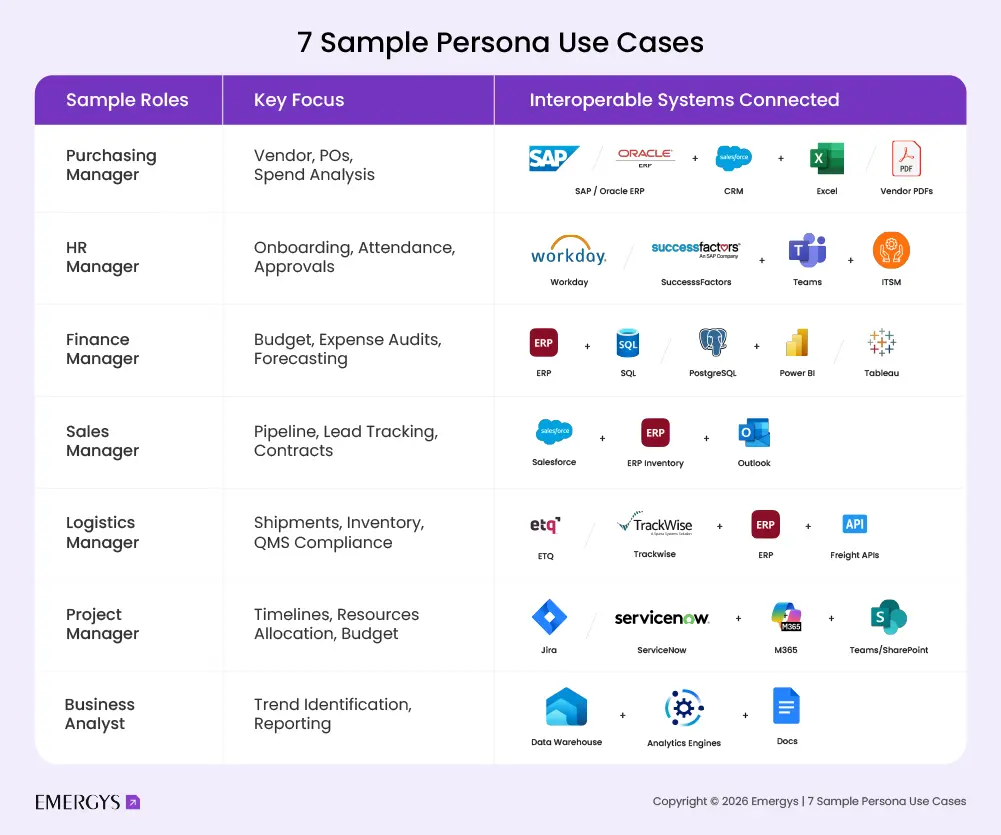
The Purchasing Manager: Streamlining Orders and Spend Analysis
Primary Responsibilities: Manage vendors, orders, and operational spend.
The Manual Bottleneck: Reconciling purchase orders in SAP with vendor contracts stored in SharePoint, while tracking delivery schedules in external vendor portals.
The EMY Scenario:
The Purchasing Manager asks EMY: “Which open purchase orders for Supplier X are at risk of delay, and what does our total cost with them this quarter?”
EMY queries the ERP (SAP/Oracle) for open PO status, cross-references recent vendor emails in Outlook, pulls contractual delivery terms from SharePoint, and returns a unified summary. It can then automatically trigger an expedite request via email or update order status in the ERP without the user switching screens.
The HR Manager: Automating Approvals and Employee Workflows
Primary Responsibilities: Manage employee attendance, onboarding, and internal approvals.
The Manual Bottleneck: Coordinating leave requests, equipment procurement, and system access permission across separate HRMS and ITSM tools.
The EMY Scenario:
An HR Manager prompts EMY: “Show all pending leave requests for the engineering team that conflict with project deadlines next month.”
EMY cross-references attendance schedules in Workday or SAP SuccessFactors with project deliverables tracked in Jira or ServiceNow. If an approval is granted, EMY updates the HR system, adjusts team calendars in M365, and notifies the line managerial through a single interface.
The Finance Manager: Real-Time Budgeting and Variance Tracking
Primary Responsibilities: Track budgets, expenses, and produce real-time financial reporting.
The Manual Bottleneck: Pulling monthly expenditure reports from the ERP, running calculations in Excel, and manually updating board presentations in PowerPoint.
The EMY Scenario:
The Finance Manager asks: “Identify all departments exceeding their Q3 travel budget by more than 10% and pull top vendor line items for each.”
EMY connects directly to SQL/Oracle databases, processes ledger data in the ERP, cross-checks against analytics models in Power BI, and formats an instant expense summary table—drastically cutting monthly closing cycles.
The Sales Leader: Unifying Pipeline and Inventory Insights
Primary Responsibilities: Monitor leads, opportunities, and customer sales pipelines.
The Manual Bottleneck: Checking CRM opportunity stages, emailing logistics to verify stock availability, and working with finance to verify credit limits.
The EMY Scenario:
A Sales Director asks: “What is the probability of closing the Acme Corp deal this week, and do we have enough inventory in warehouse B to fulfill the order?”
EMY queries Salesforce for deal status and win probability, interfaces with the ERP inventory module to check live product stock, and validates customer credit limits in the finance engine, providing immediate clarity on deal execution.
The Logistics Manager: End-to-End Tracking and Quality Assurance
Primary Responsibilities: Track shipments, inventory levels, and delivery status.
The Manual Bottleneck: Tracking consignment locations across carrier APIs, cross-checking batch quality inspection logs in a QMS, and updating stock levels in an ERP.
The EMY Scenario:
The Logistics Manager prompts: “Which incoming shipments failed QMS inspection this week, and how does that affect customer deliveries in region East?”
EMY scans Quality Management Systems (ETQ, TrackWise), links batch IDs to affected customer orders in the ERP and provides an actionable remediation plan along with drafted customer alerts.
The Project Manager: Aligning Resources, Timelines, and Tasks
Primary Responsibilities: Track tasks, project timelines, budgets, and operational progress.
The Manual Bottleneck: Gathering task updates across Jira, checking resource allocations in ServiceNow, and summarizing status for executive leadership in slide decks.
The EMY Scenario:
The Project Manager asks EMY: “Draft an executive status report for Project Titan highlighting delayed tasks, current budget burn, and key risks.”
EMY extracts real-time sprint data from Jira, cost metrics from the ERP, and communication logs from Teams, outputting a clear project review ready for stakeholders.
The Business Analyst: Rapid Data Synthesis and Trend Identification
Primary Responsibilities: Analyze multi-department data, identify operational trends, and generate strategic insights.
The Manual Bottleneck: Writing custom SQL queries, exporting datasets to CSVs, cleaning data manually, and building visual models in Tableau or Qlik.
The EMY Scenario:
The Business Analyst asks: “Correlate customer satisfaction drops in Q2 with product return reasons and supply chain delays.”
EMY performs a cross-domain correlation across CRM support tickets, QMS return categories, and Logistics freight records, surfacing key drivers in natural language alongside recommended operational fixes.
Strategic Value for the Enterprise
Deploying a managed Cross-platform AI Assistant like EMY transforms technology infrastructure from a collection of isolated tools into a coordinated operational environment.
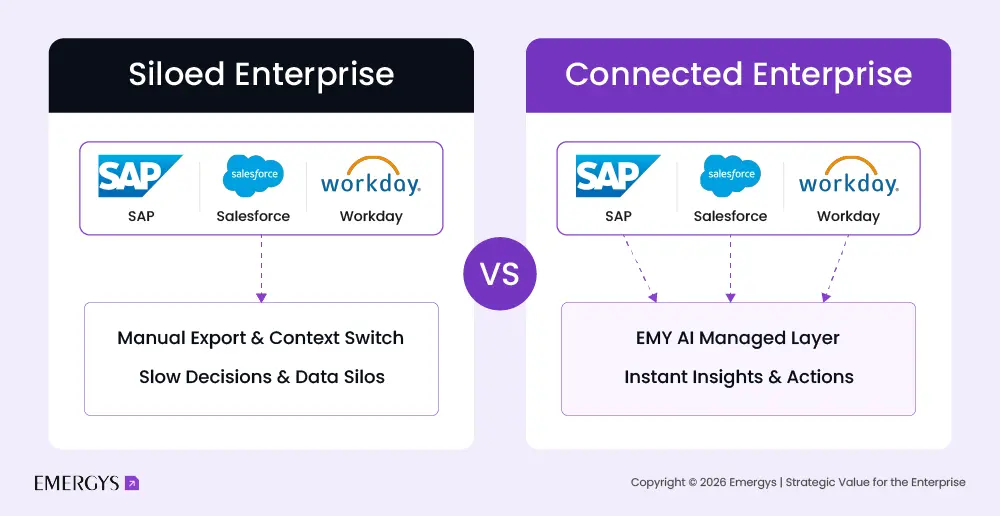
Key Business Outcomes of Cross platform AI
Break Data Silos: Unify structured databases, SaaS tools, and unstructured documentation without re-architecting underlying core systems
Accelerated Decision-Making: Reduce time-to-insight from days or hours down to seconds via natural language interfaces
Better Organizational Productivity: Automate redundant, multi-system manual tasks, freeing teams to focus on strategic work
Enhanced Data Accuracy: Eliminate human data-entry errors caused by manual copy-pasting between platforms
Scalable and Future-Ready Architecture: Easily plug new tools, cloud services, and custom APIs into EMY’s flexible integration layer as your organization grows
Enterprise-Grade Governance: Ensure strict adherence to security protocols, RBAC standards, and regulatory frameworks through Emergys’ dedicated managed service model
Transforming Enterprise Intelligence with Emergys
Adding more software tools to an enterprise often increases operational complexity rather than resolving it. The key to scalable digital transformation is not buying another platform—it is orchestrating the platforms you already own.
As a managed service, Emergys’ EMY brings intelligent orchestration directly to your team. By serving as a secure, role-aware Cross-platform AI Assistant, EMY unlocks the true value of your software ecosystem, allowing your organization to act faster, operate smarter, and scale with confidence. Talk to our experts.
Author:
Varun Singh
Head of Technology | Emergys
With over two decades of experience, specializing in digital transformation, enterprise IT, AI, machine learning, security architecture, and scalable technology solutions.
FAQs: EMY Cross-Platform AI Assistant
-
What exactly is EMY, and how does it differ from a standard AI chatbot?
Standard AI chatbots typically operate within a single application or rely on basic data retrieval. EMY is an enterprise-grade Cross-platform AI Assistant that sits above company’s entire tech stack. It leverages multi-modal reasoning and workflow discovery to not only answer questions via Natural Language Query but also execute complex, multi-system tasks—like checking SAP inventory, updating a Salesforce record, and messaging a user on MS Teams, all from a single prompt.
-
Why is EMY delivered as a managed service rather than off-the-shelf product?
Enterprise architecture is never static. APIs update, schemas change, and business logic evolves. An off-the-shelf AI product often becomes brittle and breaks when underlying systems change. By delivering EMY as a managed service, Emergys continuously maintains the integrations, fine-tunes custom persona workflows, and updates security guardrails company’s AI capabilities scale seamlessly alongside their business.
-
Which specific enterprise systems and data sources can EMY connect with?
EMY is designed for deep interoperability. It natively integrates with:
- ERPs: SAP, Oracle, Microsoft Dynamics 365
- CRMs: Salesforce, Microsoft Dynamics
- ITSMs & HRMS: ServiceNow, Jira, Workday, SAP SuccessFactors
- Analytics & BI: Power BI, Tableau, Qlik
- Productivity & Files: Microsoft 365 (Teams, SharePoint, Outlook), CSV, PDF, Excel
- Backend: SQL, PostgreSQL, MySQL, and custom REST/GraphQL APIs
-
How does EMY handle data security, access control, and compliance?
Security is embedded into EMY’s core architecture. The platform operates on a strict Role-Based Experience model, integrating with your existing identity and access management protocols. This means a Sales Manager and a Logistics Manager using EMY will only have access to the data, dashboards, and system actions that their specific enterprise credentials permit. Emergys strictly maintains enterprise-grade security, data masking, and compliance monitoring as part of the managed service.
-
Can EMY trigger workflows, or does it only pull reports?
EMY is capable of Intelligent Actions. While it excels at delivering Unified Insights by synthesizing data from disparate systems, its true power lies in cross-platform orchestration. Authorized users can instruct it to create purchase requisitions, approve leave requests, or generate automated status reports directly within the connected native systems.
-
Is EMY a one-size-fits-all interface for the whole company?
No. EMY utilizes Persona-Specific Agents. Intelligence is mapped to the individual’s Database access. A Finance Manager will experience EMY as a tool for tracking budgets and expenses across ERP and BI tools, whereas a Project Manager will experience it as a hub for tracking tasks, timelines, and resource allocation across Jira and Microsoft 365. The interface and capabilities adapt to the user.
-
How does EMY reduce “context switching” for employees?
Context switching—the act of constant login and logout of different software portals to complete a single workflow—is a massive drain on productivity. It acts as a centralized neural layer. Instead of a business analyst exporting data from an ERP, cleaning it in Excel, and uploading it to Tableau, they can simply ask agent to correlate the data and generate the insight in natural language, eliminating the manual steps.